Glimpses Into The World Of UFOs In Summer 1973
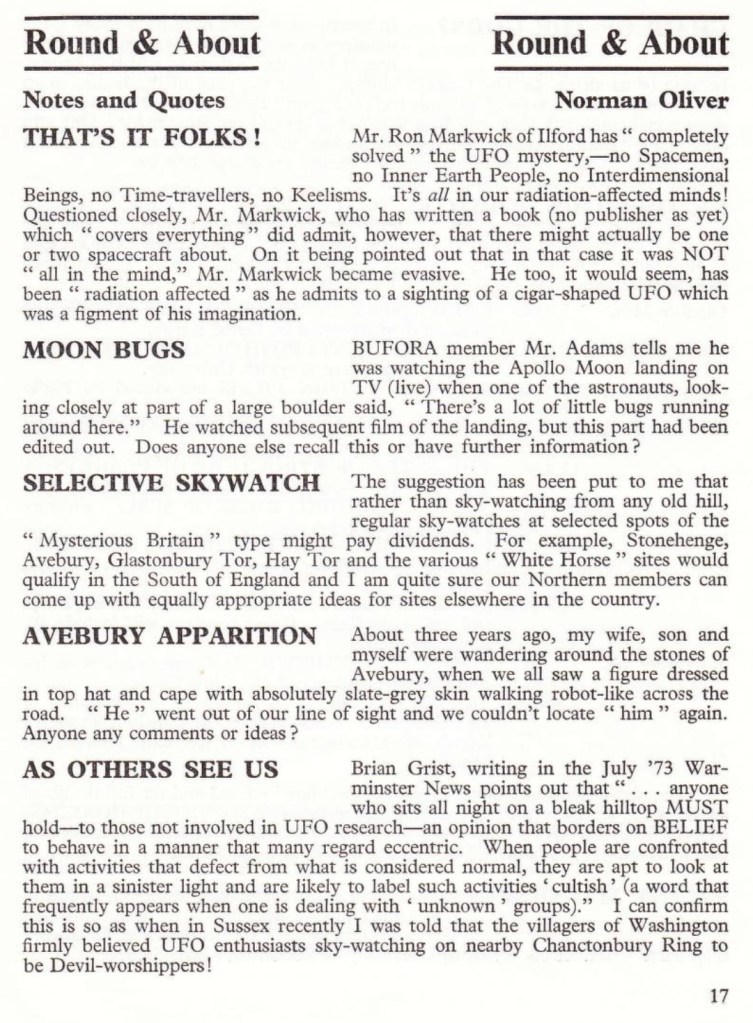
Above is the Notes & Quotes page from August 1973’s The Bufora Journal, as published by The British U.F.O. Research Association. It has all of the charm and fascination of the letters page of The Fortean Times, and clearly stands as an ancestor of it. I greatly love and respect these magazines, sceptical, rigorous, humane, curious and good humoured as they are. At moments, they can make me howl with laughter too. And, disbeliever that I am, I always find them fascinating. As did Agent Mulder’s famous poster, I do want to believe.
The Fantastical In Today’s UK Album Charts
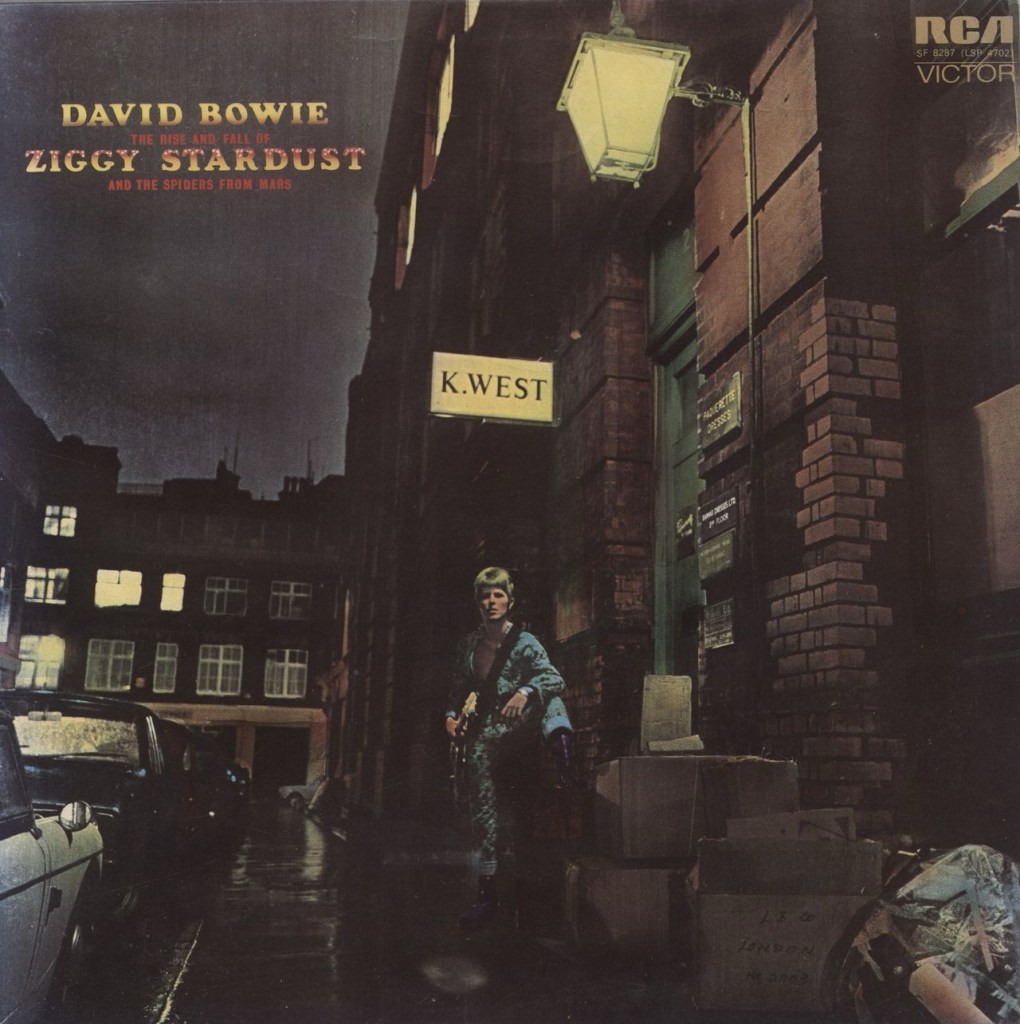
Amazing, David Bowie’s Ziggy Stardust was not only still in the UK album charts after a year on release: in this week in 1973, it was nestled in snugly at #7. That was only 5 places below Bowie’s newest LP, Aladdin Sane, with its Drive In Saturday serving as the most fantastical of DB’s more recent tracks. Just one place below was 1971’s Hunky Dory, which had finally gained the sales success it had always deserved due to the belated success of its key track Life On Mars as a single.
It was Bowie’s imperial period. Even the sprawling and distinctly uncommercial heavy rock of The Man Who Sold The World had reached number 29. As if that wasn’t enough, Mott the Hoople’s All The Young Dudes LP and Lou Reed’s Transformer, both produced to this degree or that by Bowie and Mick Ronson, were at #16 and #27 respectively. It all added up to a remarkable success.
Yet for all that the Bowie of the period has sometimes been viewed in the light of his success with singles, the UK 45” Charts for this week featured just one of his songs, namely Life On Mars, which had sunk to #13 after peaking at #3.
The Arrival Of The One And Only E-Man
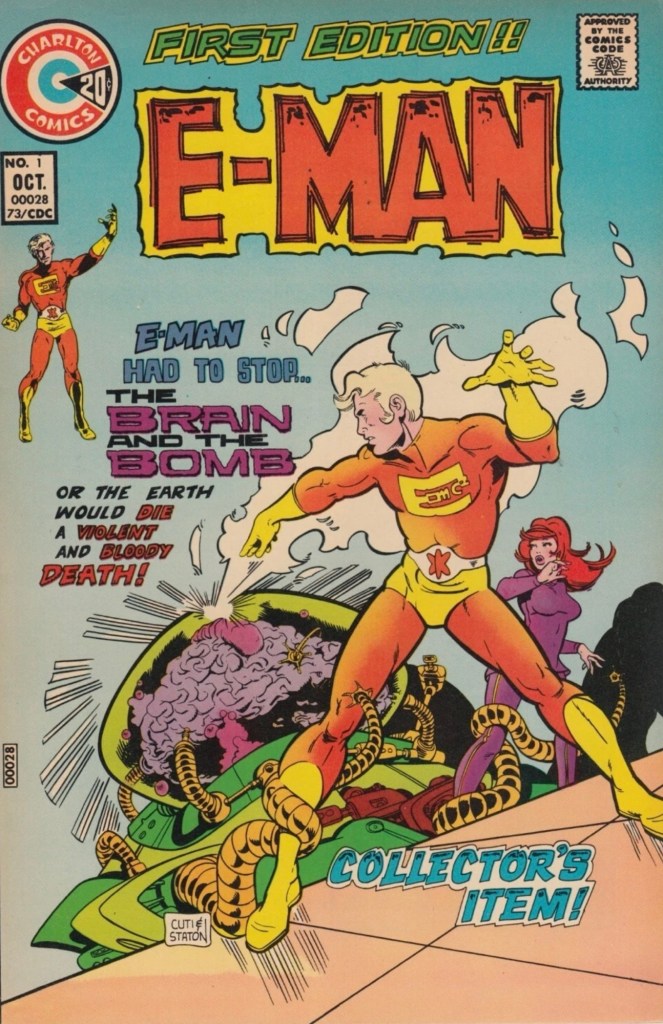
Almost certainly the most charming superhero comic of August 1973 was E-Man #1 by writer Nicola Cuti and artist Joe Staton. Much of its appeal lay in what it wasn’t. By its very design combined with its cheapest-of-the-cheapest production values, it clearly wasn’t either a Marvel or DC super-person book, which immediately marked it out as odd and interesting. Nor did it sit comfortably with either of the Big Two’s storytelling traditions. Cuti despised what superheroes had become, while Staton, a young and still-developing storyteller, had a style that, for all it sweetness and invention, wasn’t yet ready for the bigger leagues. Between the two of them, they created the tale of a sentient alien energy creature who, being able to change its physical form, adopted the form on Earth of a superhero look-alike. For awhile, the result was thoroughly amusing and compelling, and, for those who were in the habit of looking back into comics history, redolent of lost classics such as Jack Cole’s Plastic Man.
E-Man never sold too well, and it lost its way somewhat when the character’s close human personal friend Nova Caine became energy charged too. No longer a fish out of water, but rather one of several superpeople, E-Man from that point onwards began to feel much less idiosyncratic and, as a consequence, much less compelling.
The Almanac Of The Fantastical will return tomorrow…
.

 The Almanac Of The Fantastical