
Rising in the Billboard Top 100 singles during this month in 1964, Jumpin’ Gene Simmons’ Haunted House, a cover of Johnny Fuller’s 1958 hit. A disappointingly limp novelty track, it’s a daft horror tale played entirely for giggles. Very occasionally it achieves its aim. After all, Robert Lee Geddins’ lyric contains some interestingly unsettling moments in amongst the throwaway lines and rhymes:
“From out of space there sat a man,
On the hot stove with the pots and pans.
I said that’s hot, I began to shout,
He drank a hot coffee right from the spout.
He ate the raw meat right from my hand,
Drank the hot grease from the frying pan.
He said to me, now you better run,
And don’t be here when the morning come.”
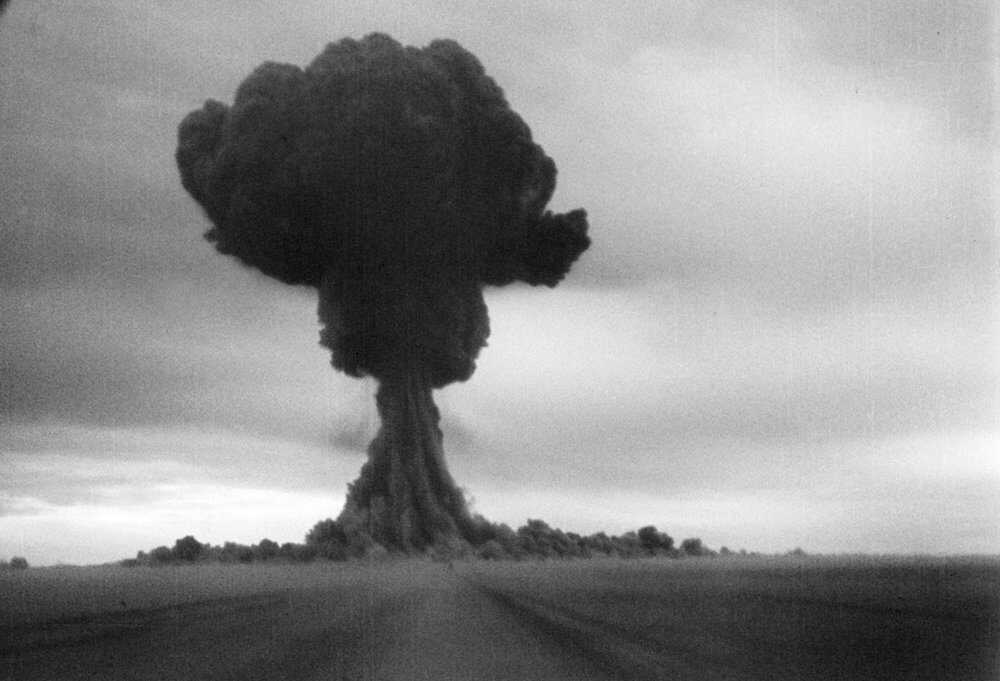
On This Day In Pseudo-Science – “Has Russia Learned How To Change The Weather?”
In today’s Leicester Mercury, Iain Ferguson declared that “Something strange is happening to our weather”. Being as vague as dabblers in pseudo-science typically are, he randomly stuffed a grab-bag of apparently anomalous weather events: “abysmal cold in the Mediterranean”, Italy’s “sunny south” becoming snowbound, “the Tiber … frozen for the first time in 500 years”, raised levels of snow in Australia and South Africa and blizzards in Britain and Japan. Surely this proved that something was seriously wrong? Could the cause of it be those darn Ruskies?
There is always an “expert”, and often a laboratory’s coffee room full of them, in these stories. Here the star witness was one “Jerome Namais, head of the Extended Forecast Section of America’s Weather Bureau’, who was quoted as wondering whether all of this weather was connected to a supposed improvement in the U.S.S.R.’s winters. I have no idea if he was being misinterpreted, but he was apparently wondering whether “Russia” had cracked “scientific weather control”. Although presuming that correlation is the same as causality doesn’t seem particularly scientific from this distance in time.
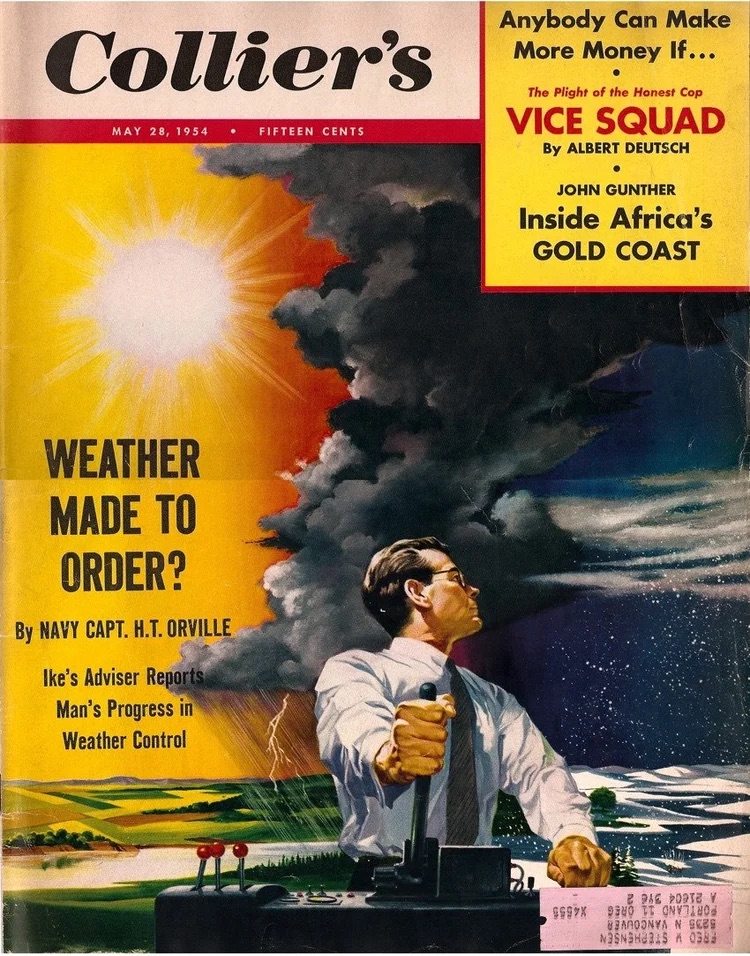
Next to be called to the court of public opinion were “Prominent American scientists Dr Bernard Vonnegut and Dr Gilbert Plass”, who apparently believed a “weather war” may have already kicked off. Perhaps, Ferguson wrote, the large number of atomic bombs exploded in the atmosphere by the U.S.S.R. had been designed to deliberately reroute the “important air currents responsible for (the) weather.”
The answer to the question posed in the article’s headline was, as you will have noticed, “no”. The truth of the whole matter was that the whole human race was changing the weather. Who needed nukes when fossil fuel was there to consumed? It’s a habit of dependency that we’ve yet to break, even as the “weather system” alters disastrously around us.
The Moon Within Reach And Poor Colonel Dare
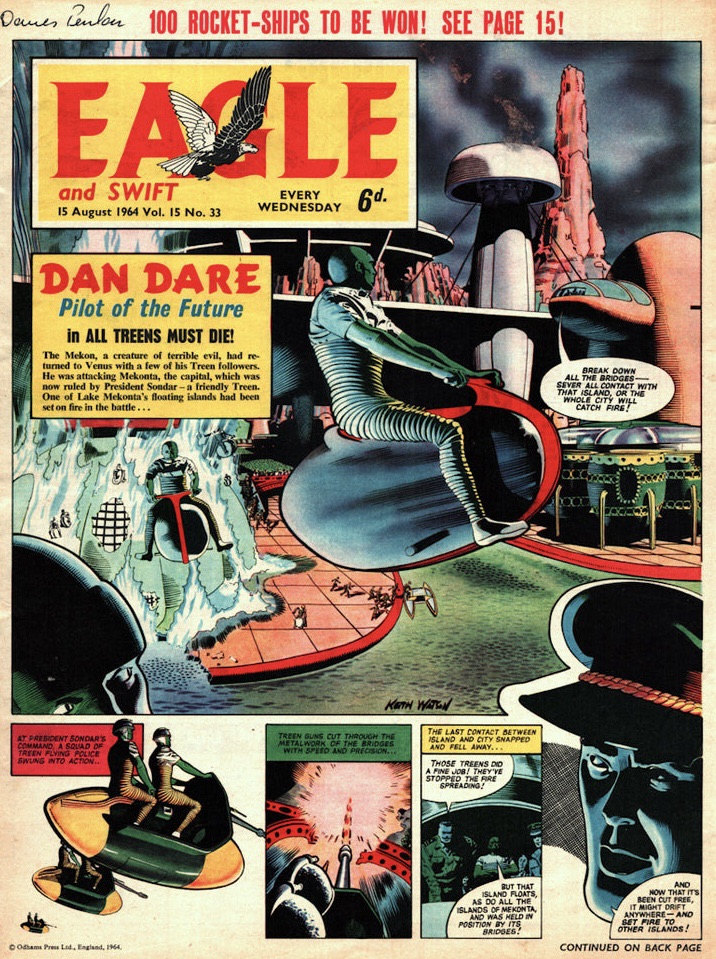
This front-page of the week’s Eagle comic in 1964 featured, as it had for most of the years since the comic’s launch in 1950, Dan Dare. There was, for a longtime, a myth that the years since its creator Frank Hampson’s sacking in 1959 had seen Colonel Dare’s adventures wither away to worthlessness. But Keith Watson’s gorgeous storytelling in the above cover can, on its own, put that assumption to rights.
Yes, it’s true that the strip wasn’t what it had been, but that’s what happens when you get rid of a comics genius like Hampson. Yes, the strip’s quality at moments after his enforced departure had been variable. (Dan had even been removed for a while from the front cover.) And, yes, it’s true that attempts to update the strip’s 50s-futuristic designs had left it feeling diminished rather than enhanced. But Watson, who had worked with Hampson during the golden years, created some truly outstanding sequences.
For all of that, Dan Dare’s time as a published character was to be limited. In 1967, his feature was cancelled, or, as his last published pages put it, he was retired from his frontline duties after distinguished service and promoted to Space Fleet Controller. It seems odd today to think of Dan Dare struggling for an audience in an era saturated with a cultural obsession with space. Cultural icons like Dare are rare and valuable properties. He shouldn’t have been allowed, after the manner of old soldiers, to just fade away.
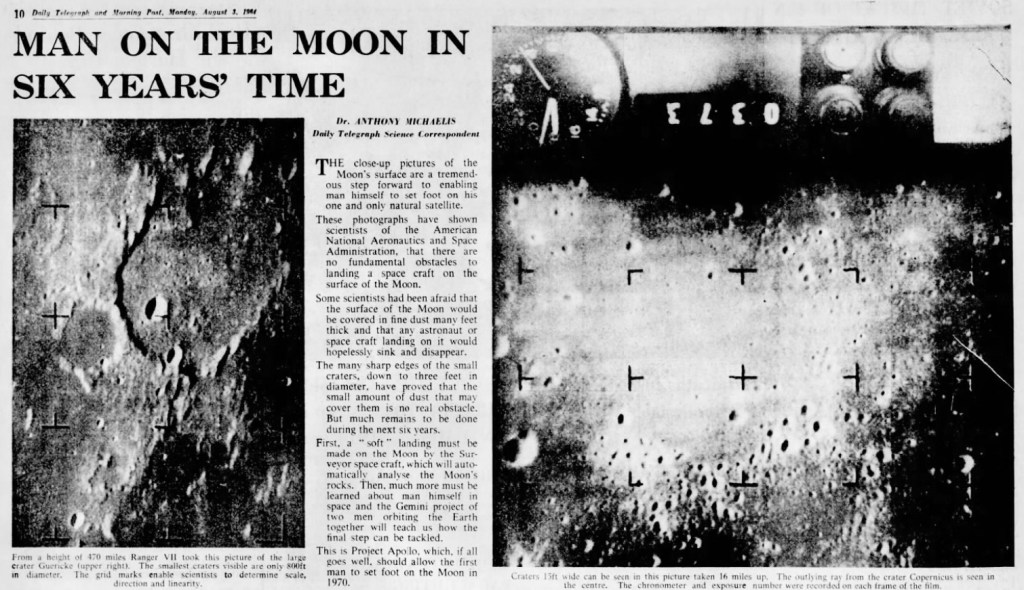
But if one generation of space icons often seemed to be struggling to survive, the business of winning the space race out in the real world was clearly thriving. (Perhaps there was a correlation of sorts between the two variables?) In the scan above from the Daily Telegraph and Morning Post of this very day in 1964, we can read must have been an amazing prophecy to many readers. The Moon in just six years’ time? Project Apollo, the article assured its readers, was on schedule to achieve just that.
Of course, in just a month after five years later, Apollo 11 delivered its crew safely to The Moon and back. The future arrived considerably ahead of schedule.
The Almanac Of The Fantastical will return tomorrow …

 The Almanac Of The Fantastical