
The London Day By Day column in August 2nd 1972’s The Daily Telegraph carried gossip about a purported plan by Arthur C. Clarke to celebrate, as it were, the end of the Apollo space missions. Clarke, described in the piece as the “doyen of British science fiction writers”, was said to be planning to charter the QE2 for December 6th’s scheduled launch moonwards of Apollo 17. In the company of 1 500 fellow passengers, including, we were told, “astronauts and other assorted celebrities”, Clarke intended to watch the last of the Apollos take off from Cape Kennedy and disappear spacewards.
Even given Clarke’s famous knack for claiming the limelight, and while remembering that his friends often credited his generosity, it all seems an unlikely business. The QE2 was a massive ship of more than 70 000 tons and 1 500 guests is an awful lot of people to invite and organise. Quite apart from the possibility of the rocket’s launch being delayed or its visibility being particularly poor from wherever the ocean liner was afloat, it would all be an example of conspicuous consumption on a reputation-diminishing scale. What’s more, it’s hard to believe that anyone who was passionate about the Moon programme, and Clarke was most certainly that, would want to party into the night of its final launch. It all sounds like far too much of a beano to be true.
Having said that, the Nottingham Evening Post of November 30th 1972 did write that “100 000 people” were expected to attend the Moonshot itself, with another million watching from nearby Florida beaches. The “prospect of a spectacular night rocket show” was, apparently, a huge draw. Perhaps the idea of some kind of farewell sightseeing voyage on Clarke’s part lay at the heart of the story. Perhaps not.
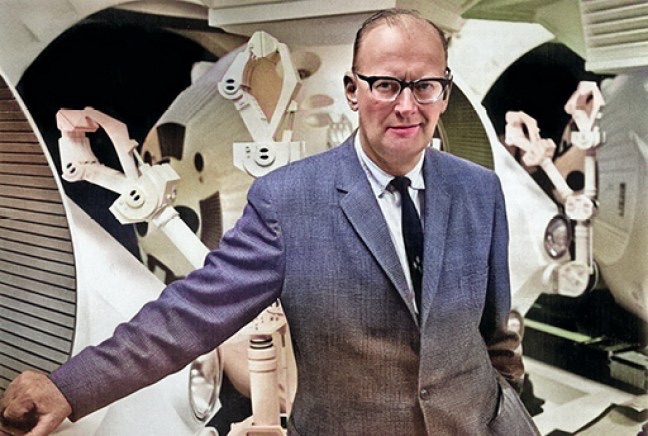
But ACC did have a remarkably high profile in the day, and it’s not surprising that stories, true or not, would attach themselves to him in gossip columns. Newspapers all across the UK during August 1972. carried his name and news of his doings. On the 26th, for example, The Grimsby Evening Telegraph’s TV listings featuring The 2001 Ideas Of The Prophet, an embarrassingly titled documentary about ACC’s life, at the 10.40pm slot on Yorkshire TV. On the 8th, Thomas Wiseman of The Guardian reviewed Clarke’s non-fiction hardback Report On Planet Three in which, we were told, the “doyen” predicted that “machines are going to take over” the world. In the Darlington/Durham Evening Dispatch of Friday 18th, Clarke’s The Wind From The Sun, a collection of sci-fi tales, was reviewed by Linda Cassell. Compared to The Best SF Stories of Brian W. Aldiss, Cassell concluded, “Mr Clarke … enlightens” as well as “entertains”. Such praise was commonplace. To the Liverpool Daily Post on Friday 10th, Clarke was “one of the great imaginative writers of today”. The Huddersfield Weekly Examiner of Saturday 26th went ever further:
“Arthur C. Clarke is perhaps the most famous science fiction writer, but while millions read his stories, the space-age professionals treat him as a serious equal.”
These are just a tiny selection of the favourable mentions of him in the UK papers during 1972.
As if to prove how famous Clarke was, he was quoted quite out of context in Bruce Sandham’s logic-mangling argument for the existence of UFOs which appeared in Saturday 5th August 1972’s Greenock Telegraph and Clyde Shipping Gazette. “If science has taught us anything”, swipes Sandham from Clarke’s work, “it is that we and our world are in no way unique”. It was disingenuous to attach these words to a piece arguing with a hysterically evident bias that intelligent life in the form of UFOs may well be found in “a space marked on the star charts as W-3”. But fame underscores legitimacy and nothing attracts cranks so much as the prospect of claiming respected public figures as fellow travelers. Clarke was always open to rational possibilities while long retaining a fascination for the paranormal. But even while hosting TV documentaries about the great mysteries of existence and the like, he was careful to avoid the appearance of buying unconditionally into lunacy. After all, he didn’t.
I haven’t been able to track down anything substantiating the report that Clarke hired the QE2 to watch Apollo 17’s launch. Perhaps he did. But what’s more important than that is that one of the UK’s major broadsheets reported that he was going to do so. I struggle to imagine any of today’s British fantastical writers with the exception of J K Rowling featuring in such an article today.

The Almanac Of The Fantastical will return tomorrow …

 The Almanac Of The Fantastical