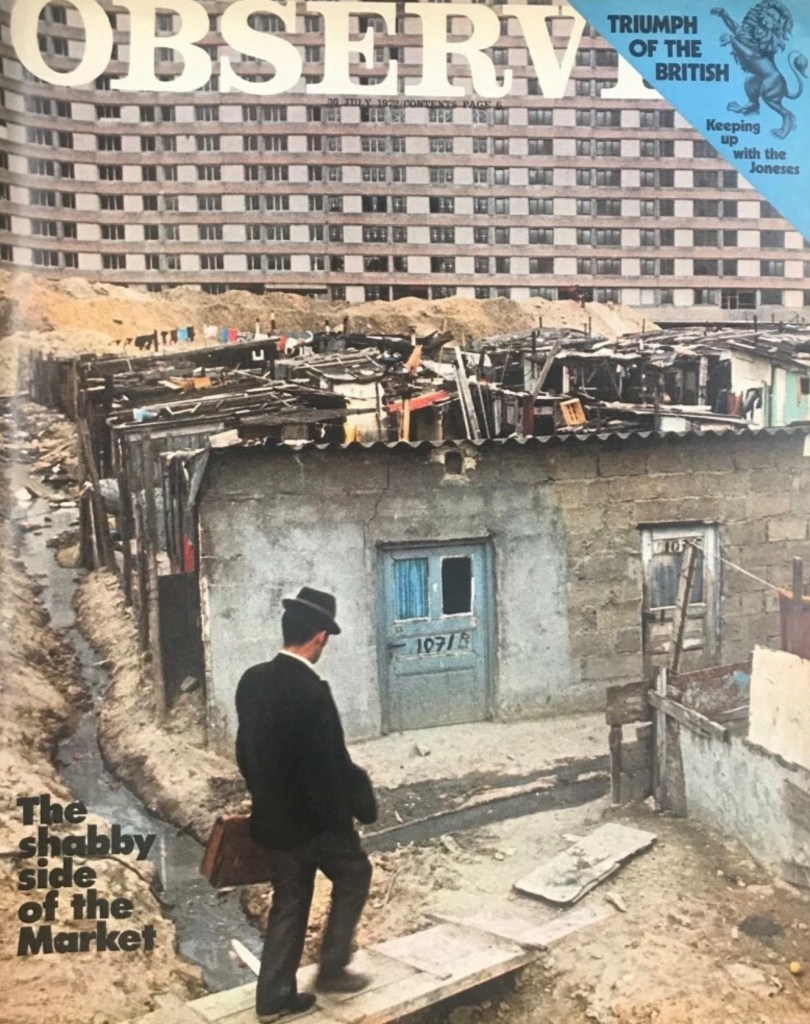
I have no idea why the Smith family took The Observer every Sunday during the 70s. It really wasn’t our typical fare. Our daily paper was the thoroughly reactionary and dumbed-down Daily Express, and I can’t imagine my parents deliberately took a once-a-week break from rightist ranting in the name of balance and palate-cleansing. Whatever their reasons, I’ve every reason to be grateful to them. In the world of cartooning, The Observer’s magazine delivered several kinds of strips that nobody else did. In that, it was an education and an encouragement. The most important example of this was Feiffer, which appeared right at the front of the magazine. (Below is the Feiffer strip from this very day, July 30th, 1972.)
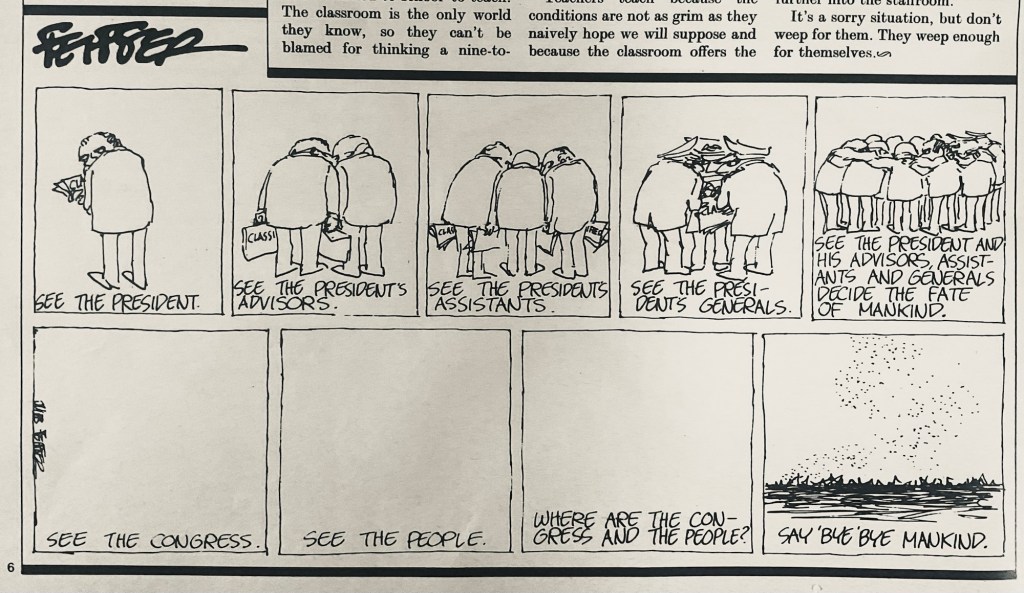
It would be many years until I twigged what a remarkable career Jules Feiffer had already had. But even without knowing anything of that, his weekly strips introduced me to the idea that comics could be adult, political, satirical, moving, and, not least, funny too. The chortle might catch in the throat, but it was a chortle all the same. (Below is from 30/7/72’s Observer too.)
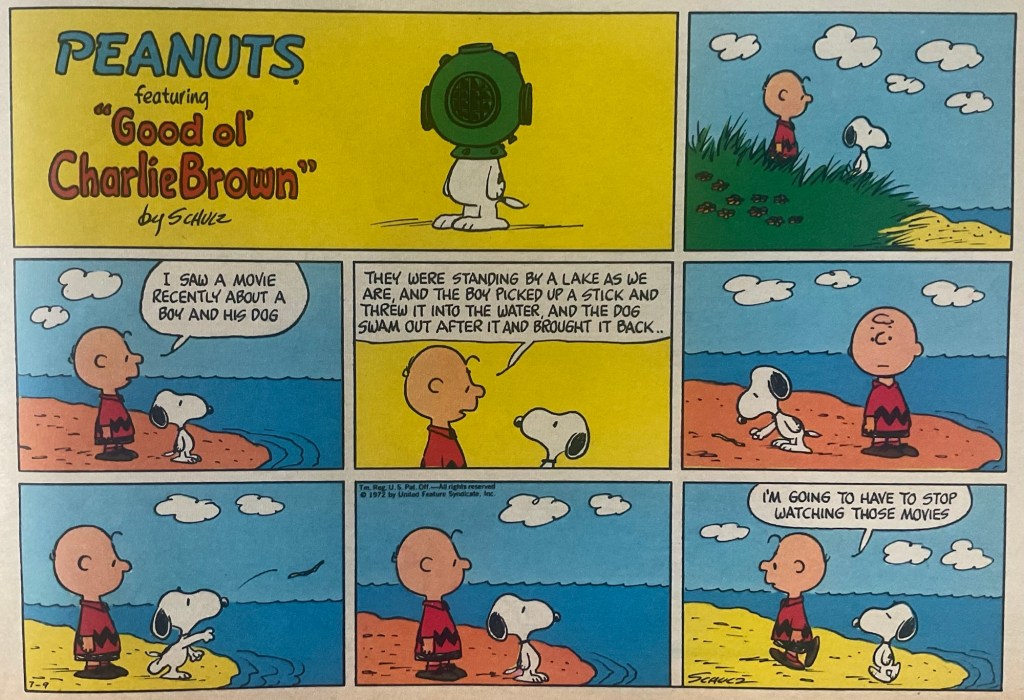
And then at the back of each Observer magazine edition was a colour Peanuts strip. To see Schulz’s Sundays was, for me at least, impossible elsewhere. I don’t think I’d ever seen Charlie Brown and Snoopy in colour before, beyond the covers of the paperback collections. As you would expect, it was revelatory.
Between Feiffer and Schulz, whole new ways of telling stories in cartoon form opened up for me. Both frequently occupied the fantastical, Feiffer with his imagined worlds, often seen through his character’s imaginations, and Schulz, obviously, with his marvellously articulate kids, animals and birds. But in both, the fantastical co-existed with the real, and in truth, the latter often took top billing. In that, these strips helped me to grasp that ‘reality’ and ‘fantasy’ overlap and intermingle. It’s a heady idea to begin to peculate through a daft lad’s dense head: that not only can you encounter sci-fi and fantasy in works marked by a kind of realism, but that the journey can work in the opposite direction too. Society, and particularly lit-snobs, often argued that the supposedly real and the inarguably fantastic were not only quite separate fictional realms, but worlds in hostile opposition to each other. It was nonsense then, I was just beginning to glimpse, and it’s nonsense now.
In a sense, the most important lessons about the fantastical that I ever got as a nipper were encountered in the cartoons printed in The Observer’s Sunday magazine.

 The Almanac Of The Fantastical