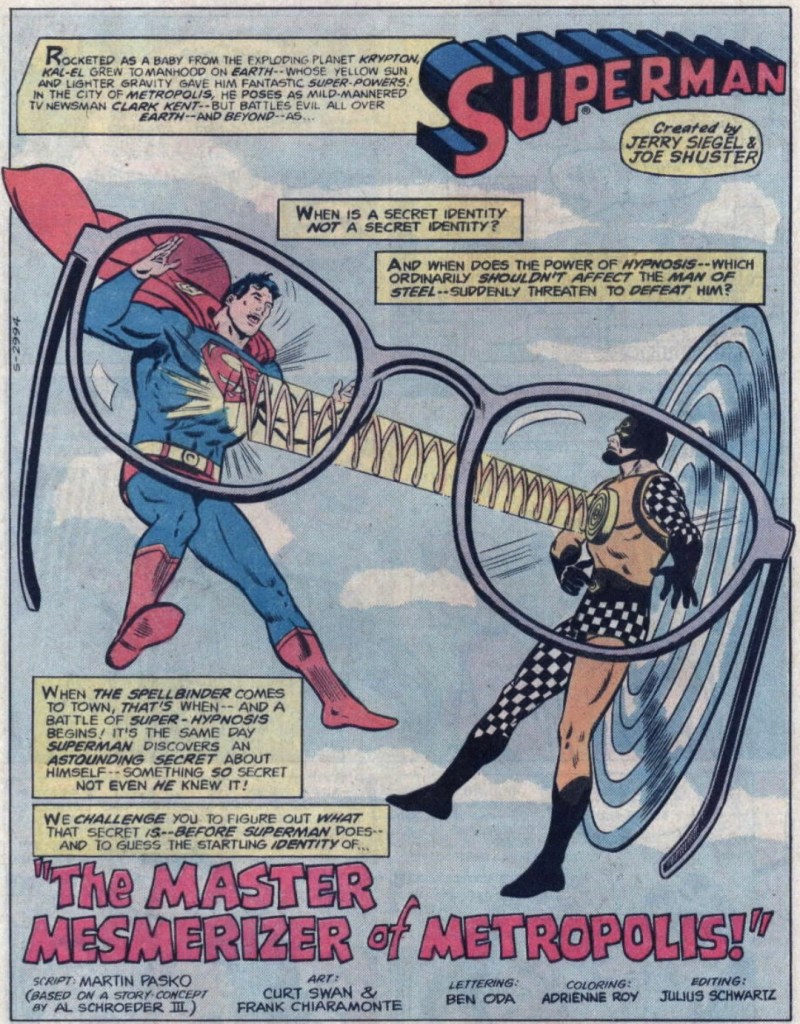
There is a remarkable, if not heartening, similarity to the way in which fantastical fans were often discussed in the past and how they’re discussed today. Take the review of 2025’s new Superman movie in The Observer of Sunday 15th July. It was respectful, upbeat and, to a surprising degree, informed. Not only did the writer know that the idea of the “hypno-glasses” used by Clark Kent in the film originated in the comics, they even nailed the very year – 1978 – in which said glasses first appeared. As if that was geek-credible enough, they also added the very month too. And yet, even in such a positive and expert review, the critic still felt the need to add the following;
“This frees the film from a boring rehash of the backstory (comics aficionados will still be able to predict the plot twists, but that’s how they get their kicks, isn’t it?) …”.
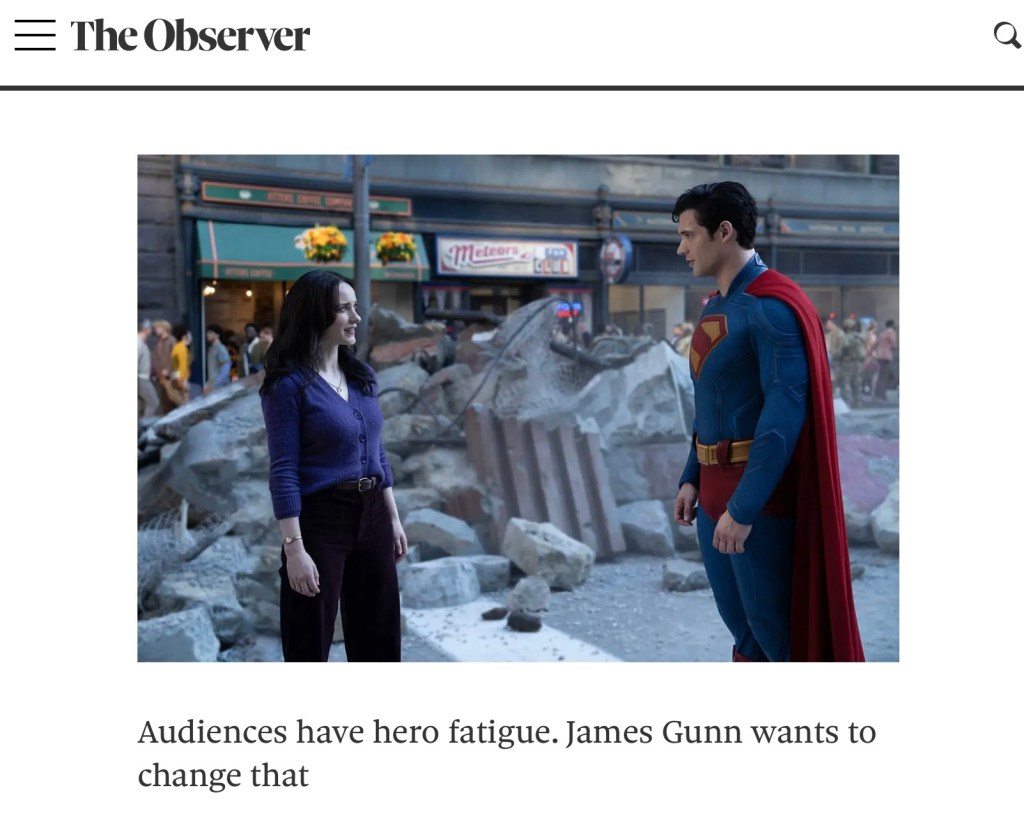
Perhaps the critic, self-conscious about their expertise as regards 47 year old comics, feared being mistaken for a “comics aficionado” themselves. Perhaps not. Perhaps they didn’t even realise that they slipped from Geek Talk into a snarky dismissal of those they presume to be geeks. Because the idea that “comics aficionados” characteristically “get their kicks” from predicting the plot twists of movies is, surely obviously, neither accurate or fair. (Some may be like that. Some may tremble with ecstasy as they do so. I’ve never met them, but it’s conceivable they exist.) Instead, it’s an expression of the age-old stereotype about the allegedly strange folks who enjoy the fantastical.
The critic’s words are grounded in three distinct and long-standing assumptions:
1. that there is such a thing as a “comics aficionado”, every example of whom is identical.
2. that these “aficionados” are all obsessives in a very specific fashion
3. and that part of this shared and fixed identity involves fervent, fannish point spotting, as if all comics fans – excuse me, “aficionados”, and boy isn’t that word doing an awful lot of work there? – are thrilled, in a kick-acquiring way – to engage in a never-ending competition to see who can first suss out where a film goes next.
That most comics fans care little if anything at all for superheroes, let alone superhero movies, quite escapes the writer, or at the very least, their ability to be precise with their language. That even many of those who love cape’n’chest insignia tales, and love them enough to know exactly when Marty Pasko first introduced Clark Kent’s identity-protecting glasses, similarly doesn’t register. Without wanting to misrepresent anecdotal evidence as generalisable data, I’ve been reading comics for nigh-on 60 years now and I’ve never gained the slightest “kick” from trying to second guess comics-derived features. I’m not even sure what it means to say people do that. Let alone an entire group of people.
I was reminded about this 21st century example of sloppy labelling and careless writing when I came across Elisabeth de Stroumillo’s piece about Los Angeles in July 22nd 1972’s The Daily Telegraph. Under the title of Why, I Wonder, Are They All So Unfair To ‘L.A.’, she questions why the city is “one of the world’s most maligned cities, endlessly cited as the nadir of urban sprawl, traffic chaos, pollution, and, of course, permissiveness (if not downright immorality)”. In a bland but enthusiastic litany of Los Angeles’ many virtues, none of which I can ever recall seeing being maligned in themselves, she praises the food, the entertainment, the vistas, the shopping and the hotels. Even the “infamous smog” is downplayed as a seasonal inconvenience and nothing more.
Only two aspects of Los Angeles inspire her disapproval:
“Some strangely-garbed science-fiction fans were holding a convention at Long Beach, it’s true, and the reprieve of an unclad sunbather who had been judged a “sex offender” may herald the thin edge of some wedge or other: otherwise the whole scene looked remarkably respectable.”
It’s not hard to unpack the attitude of Elisabeth de Stroumillo towards “strangely-garbed science-fiction fans”. To her, as she writes, they simply aren’t “respectable”. Instead, they were offered as an example of where LA fell short. But worst of all, those fans were bracketed with the report of a “sex offender” and a potential collapse in public morals. Surely no thoughtful writer would consciously place those together in the same paragraph with some cosplayers as examples of how Los Angeles falls short. It’s the kind of guilt by association that taken-for-granted assumptions inspire about what is and isn’t normal, isn’t acceptable, isn’t healthy. It’s not that de Stroumillo accused those science fiction fans of being sex offenders, or of representing a tipping point in LA’s sexual mores. But she did place them in the same section and used them as examples of Rather Unpleasant Things. I’ll bet she never thought twice about saying so. That’s how stereotypes work. It never struck her that those two things didn’t belong together.
There are far, far worse stereotypes in play in 2025, and there’s a great many individuals and groups who suffer existentially from them. Fantastical fans, despite having it better than they ever have, are faced with nothing more or less than an occasional low level hum of contempt that occasionally breaks out in open disdain about “aficionados” and “kicks” and all that nonsense. It’s ever been thus.
But it says a lot about the learned folks who still peddle such labels that they don’t even seem to realise what they’re doing.

 The Almanac Of The Fantastical