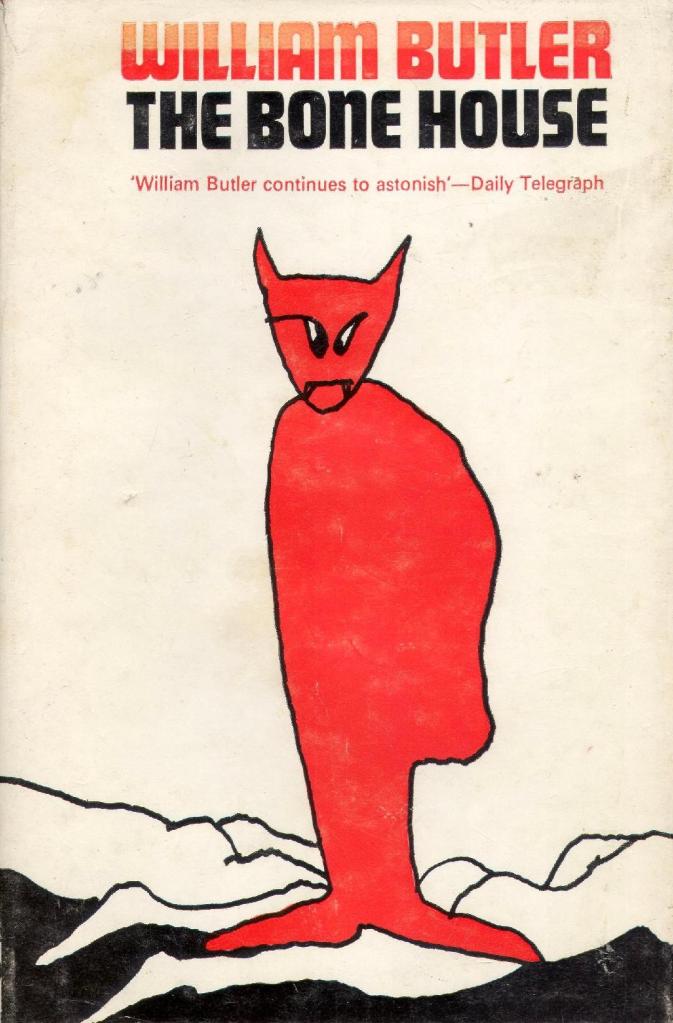
The Bone House by William Butler
You quickly learn which critics in 1972 have a problem with the fantastical. In Sunday July 9th’s The Observer, Russell Davies, who had already chalked up some previous with his scathing, even furious, review of William Peter Blatty’s The Exorcist, discussed The Bone House, a short novel in which underground tunnels are suspected of both harbouring murdered bodies and leading to Hell:
“In a way it’s disappointing to see Bultler, an eccentric and original talent, succumbing to the current outbreak of diabolism in American popular culture, but his vigorously ironical humour manages to keep events on a small-scale, nowhere claiming to deal with anything more formidable than local legend. Butler flirts with evil, but he does not espouse it – which is a relief at a time when Beelzebub looks like making a typically boring comeback in the lively arts.”
Entire traditions of storytelling are, it strongly appears, beyond the pale where Davies was concerned. They offend his moral/religious sensibilities. He finds them by their very nature tedious. It’s a snobbery that’s quite overwhelming, and it’s hard to think of a more disdainful and dismissive phrase than “the current outbreak of diabolism in American popular culture”.
David Benedictus, writing in The Daily Telegraph of Thursday 6th July, felt somewhat warmer about Bulter’s horror tale. He considered The Bone House, eccentric as he found the writer’s style to be, “quirky and precise”, with the book’s greatest strength lying in Butler’s “bizarre portrait gallery of small-town types”. Kindly, Benedictus advised ‘the insecure’ to avoid the book, given “that the forces of evil get so very much the best of the metaphysical arguments’. Yet despite The Bone House being, he insisted, overpriced, it was also “mordantly funny and reeking with allegory … an enticing curiosity.”
In The Guardian, sister paper to The Observer, Christopher Wordsworth hooved closer to Davies than Benedictus. Once again, there’s a sense of the lit-snob’s Olympian judgement, with the very idea of the fantastical deemed suspect and nigh-on unnecessary.
“Some cranky humour in this allegory of innocence and ancestral taboos, suggest Thornton Wilder and T. F. Powys in collaboration, but an interesting writer here is a little too thorny and apocalyptic”.
C’mon, chaps, the review seems to insist. Let’s not have too much of that apocalyptic stuff.
What none of these writers seem to have noticed is that Butler’s novel is as funny as it was macabre. He was clearly playing with genre, and using it to raise a few questions about serious matters, rather than in any way lowering his art into populist indulgences. (Although it’s worth saying that that can be exceedingly worthwhile too. ) What Davis calls the author’s “vigorously ironical humour” quite obscures the novel’s tone and purpose. From beginning to end, Russell gives every impression of enjoying the heck out of his own storytelling. “Vigorously ironical” as a phrase makes The Bone House sound far too stiff and far too depreciatingly purposeful. Similarly, what Wordsworth describes as “Some cranky humour” succeeds in entirely missing the gleefulness that marks the book from its very first line. Similarly, when Benedictus calls The Bone House “mordantly funny”, he seems to have been confusing the trees and the wood. The humour isn’t an aspect of the novel. The novel is a comedy. Some of it is mordant, much of it isn’t. As for the critic’s description of Russell’s cast as “bizarre … small-town types”, it’s enough to make The Almanac wonder if Benedictus ever encountered anyone from beyond the borders of bookland and its allied territories. Exaggerated Russell’s characters are, to a purposeful degree. But they’re only bizarre to somebody who is remarkably innocent when it comes to a more everyday existence.
I don’t know if Russell was disappointed by the response to his novel. (It certainly doesn’t seem to have received a paperback edition.) At this distance, it does seem as if his critics weren’t the equal of his work.

 The Almanac Of The Fantastical