So what was the state of play in the world of fantastical fiction in the UK for the first six months of 1972? We might start by looking at how three noteworthy fantastical novels were released and reviewed during that period:

The worlds of American and British fantastical novels were often working on very different timetables in 1972. Take, for example, William Blatty’s The Exorcist. It had been published in America in a hardback edition on May 5th 1971. Massive sales and public controversy, the two feeding off one another, followed. But the novel only reached Britain’s reading public on Monday 31st 1972, some 8 months later.
Not only were publication schedules, from the perspective of 2025, strangely askew. So too was the press’ response to what was placed before them. In retrospect, The Exorcist is clearly one of the most important, if not the most literary, of the year’s fantastical books. But to try and track its reviews in the British press in 1972 is to see how disorganised release schedules and publicity campaigns could be. For example, the Huddersfield Daily Examiner didn’t run a review until its March 2nd edition. (Run “your fingers over the glaze and you will find plenty of flaws”, wrote ‘A.T.’, who goes on to the argue the book’s fundamental flaw is “sensationalism” rather than “blasphemy and obscenity”.) The Cambridge Evening News’ review only saw print on April 15th. (“It is strange, though, that an author capable of riveting the reader’s attention at the end is unable to keep his interest throughout”, opinionated Alan Kersey.) From our age of instant reviews and almost-immediate redundancy, this seems ridiculously slack and counter-productive.
The Observer was quicker off the blocks. On Sunday 6th February, it ran an absurdly convoluted and censorious review by Russell Davies:
“A bare outline of the plot does not explain the book is, on the whole, objectionable … My objection … is that it is psycho-theological disquisition of limited interest that derives its narrative power from a combination of dread and extreme physical disgust … and that Mr Blatty plays upon revulsion and fear (a social fear since the Manson Satanist killing) in order to propagate a religious view.”
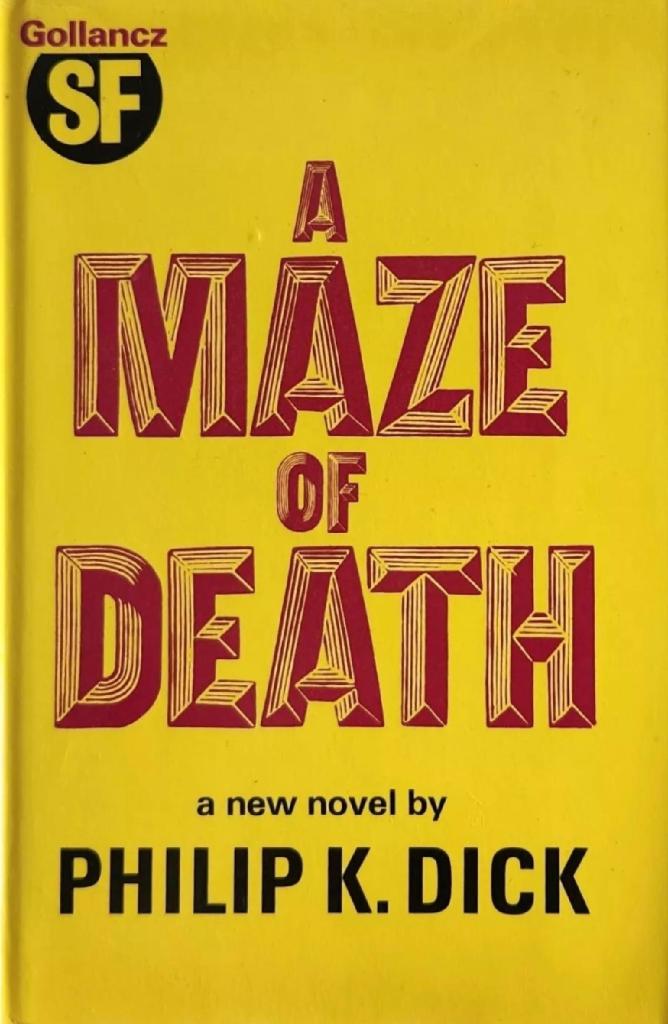
As with The Exorcist, Philip K. Dick’s A Maze Of Death sits comfortably in the histories of the period as a product of 1971. But for UK readers, it was most likely first encountered in 1972, where, in ads during late February, publisher Gollancz trailed it as “Philip K. Dick’s new novel”. (‘Latest’ would’ve been much more accurate.) Again, as with Blatty’s book, A Maze Of Death met with some distinctly sniffy reviews in what was then respectfully known as the quality press. In The Observer of Sunday 5th March, Henry Tilney didn’t hold back in damning the book for being a “slovenly galactic Agatha Christie-type thriller, desultorily concerned with a troupe of stranded psychopaths. Hilariously written (with) creaky metaphysics”. Even Dick’s forward to the novel, Tilney wrote, would be enough to put readers off the pretentious, ill-informed and poorly written tale.
The local press was considerably kinder. For example, Stephen Craggs in Darlington’s Evening Despatch – and yes, that was the archaic usage of “despatch” – wrote that “Fantastic though the situation is, it seems entirely credible, for PKD writes so convincingly that even shadows become solid and substantial.” The Bolton News on Saturday 11th March was more succinct but equally positive, awarding A Maze Of Death “full marks”.
Yet A Maze Of Death wasn’t the only Philip K. Dick book to be reviewed during the first 6 months of 1972. With fantastical novels being frequently reprinted behind (mostly) new covers, the force by which a new book might hit the marketplace could be diluted by the jostling reappearance of older titles. It could certainly make for a confusing state of affairs. On Saturday 15th January, the Birmingham Post published James Clayton’s review of 1969’s Galactic Pot-Healer and described it as being about “nervous people in a typically Dick future (where the robots answer back)”. It was, he concluded, “great fun”. And in January 6th’s Manchester Evening News, Dick’s Solar Lottery, his very first novel from 1955, was said to be “one of the week’s new Arrow paperbacks”. If PKD had had a publicist trying to maximise his appeal in the UK’s marketplace, they’d have surely been tearing their hair our.

Once again, William Burroughs’ The Wild Boys: A Book Of The Dead was a novel published in the USA in 1971 and then only belatedly printed over the other side of The Pond. In direct contrast to The Exorcist and A Maze Of Death, and to no surprise when the ways of the lit-snob are taken into consideration, The Wild Boys received respectful and positive reviews in several of the broadsheets while being, when it was deigned any attention at all, treated with contempt elsewhere. The book’s publisher Calder responded to the more upbeat analyses in an advert which quoted the likes of Francis King from The Sunday Telegraph – “A work of near-genius” – and John Whitley’s belief in its “general brilliance”.
There are those of us who fully recognise the importance of Burroughs in terms of both his method and his content while still finding him dull and, quite frankly, unreadable. Martin Amis – for it was he – in The Observer of Sunday 11th June 1972 offered some little solace to that point of view. There were, Amis wrote, some 40 pages in the middle of the text that were so unrelentingly sexually graphic and extreme that “they were of only academic interest to the heterosexual reader”. (On the other hand, this does stereotype gay readers as sharing, by their very sexual identity, Burroughs’ obsessions, while assuming that nobody else – Amis seems to assume an either/or model of sexuality – can have an interest in the sexual world of the novel.) For the rest of The Wild Boys, Amis was full of praise for Burroughs’ characters, who “are.. (the) ironist’s version of nature without nurture, like Swift’s Yahoos – filthy, treacherous, dreamy, vicious and lustful” while describing the book as “a tour de force of delicious erotic imagery, clipped and spliced like a stream-of-consciousness shooting script”.
In The Guardian of the 25th May, Gabriel Pearson asked whether a book so pornographic and plotless could be worthy of our time. The Wild Boys, he began, was compulsively readable and accessible. But, he added, “there will be those who say that … Burroughs, far from parodying the mechanisms of pornography, has willingly given himself over to them … This charge is not easily rebutted”. Despite finding the novel plotless and obsessive and challenging, Pearson came down in its favour because of Burroughs’ “concerted attempt to imprison the reader inside his own compulsions”, the power of which makes the book one “to be reckoned with”.
By contrast, the Evening Standard of July 18th insisted with a flailing pseudo-humorous tone that The Wild Boys’ was so extreme and excessive that it’s “like a parody of all its worst predecessors”, concluding:
“Hey man if this is writing what happened to speech?”
With a considerably more laudable control of English, but with far less of a sense of humour, W. J. Nesbit in The Northern Echo of Friday 16th dismissed The Wild Boys without qualification. It was, he decried, “No entertainment at all”. Instead, it was a celebration of “lust and violence, rhapsodical homosex and … cruelty”. The writing, Nesbit concluded, was “hysterical, and the general effect repellent”.
It’s interesting, at this considerable remove, to note that the various reviewers were most concerned with the questions of “is it art?” or “is it decent?”. The matter of whether The Wild Boys could be considered enjoyable as a read without theoretical or moral concerns seems to have been of secondary concern.

 The Almanac Of The Fantastical